
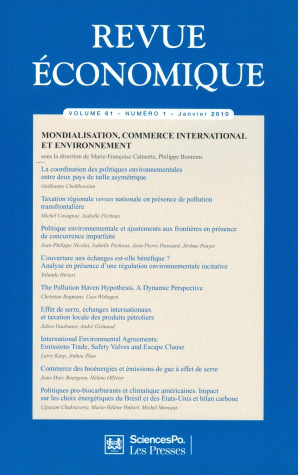
Revue économique 61-1, janvier 2010
Mondialisation, commerce international et environnement
First Edition
Ce numéro spécial de la Revue économique propose d'apporter une contribution au débat sur les effets de la mondialisation et du commerce international sur l'environnement. Read More
Coordination of Environmental Policies Among Two Countries of Asymetric Size
Guillaume Cheikbossian
We analyze strategic environmental policies in a world composed of two countries of unequal size. Strategic interactions between countries come from the imperfect competition among producers in the integrated market and from the transboundary pollution generated by the firms. We show that, in the Nash equilibrium, the larger country sets a lower tax rate on polluting activities than the smaller country. In turn, we analyze two types of coordination of environmental policies: the setting up of a supranational agency maximizing the sum of welfare and the imposition of a minimum level of taxation on polluting production. We show that, in both cases, the larger country may end up with a lower welfare than in the Nash equilibrium, and so may refuse to take part in the agreement.
Regional Taxation versus National Taxation with Transboundary Pollution
Michel Cavagnac, Isabelle Péchoux
We consider a two-country model of strategic trade with transboundary pollution. Environmental policy may be decided either at the regional level or at the national level. We study how changing the decision center impacts on, respectively, trade, firms' profit, environmental damage, regional and national welfare. We show that a centralized policy turns out to be in favour of domestic firm's profit but at the cost of a bad environmental quality. Concerning the usual criterion of social welfare, we show that the policy adopted by a regional decision-maker, only concerned by local considerations, might implement a national welfare higher than the welfare achieved by a national regulator.
Environmental Policy and Border Adjustments with Imperfect Competition
Jean-Philippe Nicolai, Isabelle Péchoux, Jean-Pierre Ponssard, Jérôme Pouyet
In a two-region model of bilateral trade with global pollution, we study how the unilateral implementation of emissions taxes affects the region. To offset the decrease in its industry's competitiveness, the regulator of the region may implement borders adjustments such as export subsidies or import taxes. We study the interaction between environmental policy instruments and border adjustments highlighting the role played by market structures and imperfect competition.
Is Trade Openness Welfare Improving? An Analysis Under an Environmental Incentive Regulation
Yolande Hiriart
We investigate whether trade openness is welfare improving for a economy affected by a pollution externality and asymmetric information. To the Heckscher-Ohlin model of a small open economy (two factors, two final goods), we add a third non-mobile production factor (a natural resource) used as an input to produce a non-tradable intermediary good. This good is produced by local firms which have private information on their technology and are regulated due to the local pollution their activity generates. Their output is essential for the production of final goods. Final goods sectors (a capital intensive industrial sector and a labor intensive agricultural sector) are competitive and open to international trade. By adopting a social optimum perspective, we show that moving from autarky to free trade is welfare improving under perfect information. We then show that this standard result no more holds when asymmetric information puts constraints on the optimal regulation of the intermediary sector.
The Pollution Haven Hypothesis
A Dynamic Perspective
Christian Bogmans Cees A. Withagen
In this paper we build a model to Investigate the relation between trade and the environment in a dynamic setting. We extend a trade model similar to Copeland & Taylor [2003] by adding capital accumulation. We characterize optimal environmental policy in autarky and under international trade. Then we analyze the effects of parameter differences across countries on steady state specialization patterns.
Greenhouse Effect, International Trade and Local Taxation of Oil Products
Julien Daubanes, André Grimaud
This article deals with the impacts of national environmental taxes on economic efficiency when pollution is global. We propose a dynamic, two-country model where the use of a non-renewable resource generates emissions accumulating in a world stock of atmospheric pollution. We assume that the two countries differ along their total productivity, their size and their endowments with the resource, which is entirely owned by one country. We show that the use of national taxes may correct the global pollution externality if governments coordinate on the temporal profile of taxes. Nevertheless, each government is tempted to strategically use the level of its tax. Countries ' heterogeneities then entail different taxes, and therefore different final prices, thus creating a new distortion in the allocation of the resource. This analysis suggests an argument against the use of environmental taxes in the fight against greenhouse effect, at the benefit of other instruments. The argument mainly relies on the diverging interests of countries in levying tax revenues on the use of non-renewable resources.
International Environmental Agreements
Emissions Trade, Safety Valves and Escape Clauses
Larry Karp Jinhua Zhao
We explain how the structure of multi-national or multi-regional environmental agreements affect their chance of success. Trade in emissions permits has ambiguous and in some cases surprising effects on both the equilibrium level of abatement, and on the ability to persuade nations or regions to participate in environmental agreements. An escape clause policy and a safety valve policy have essentially the same properties when membership in environmental agreement is pre-determined, but they create markedly different effects on the incentives to join such an agreement. The two policies lead to a qualitative difference in the leverage that a potential member of the agreement exercises on other members.
Trade of Bioenergy and Greenghouse Gas Emissions
Jean-Marc Bourgeon Hélène Ollivier
To appraise the impacts of producing and trading bioenergy on green-house gas (ghg) emissions, we develop a general equilibrium model with trade of a world economy involving many countries belonging to two regions, North and South. Both economy comprises two sectors, industry and agriculture, which are both responsible for ghg emissions. We assume that Northern countries have a larger endowment in effective labor than Southern countries. Whereas autarky emission levels are identical across countries, agricultural emissions are higher in South and industrial emissions are higher in North at a diversified trade equilibrium. Trade of bioenergy decreases global emissions worldwide, which increases the welfare of all consumers. While a less stringent environmental regulation in Southern countries attracts the more pollution-intensive industries, North concentrates most of the industries and becomes thereby the largest polluter contrary to the prediction of the "pollution haven" hypothesis. Trade also increases the wealth discrepancy between Southern and Northern countries.
Pro-Biofuels and Climate US Policies: Impacts on Fuel Markets and Carbon Emissions in Brazil and in The United-States
Ujj ayant Chakravorty, Marie-Hélène Hubert, Michel Moreaux
In this paper, a partial trade equilibrium model is developed to explore the impacts of us energy policies on the use and trade of first-generation biofuels (etha-nol) and second-generation biofuels (ligno-cellulosic ethanol) in the United-States and Brazil. In addition, we investigate their impacts on direct and indirect carbon emissions. The first policy is the biofuels mandatory target. The second defines a cap on carbon emissions. Our study reveals that the biofuels mandatory target encourages ligno-cellulosic ethanol production, reductions in carbon emissions being marginal. The second policy increases energy prices leading to a decrease in energy consumption as well as in direct carbon emissions. However, this policy has a significant impact on deforestation in Brazil resulting in a rise in indirect carbon emissions. The biofuels subsidy needed to reach the mandatory target amounts to us$ 1.1 pergallon. The us carbon tax reaches us $ 120 per ton equivalent carbon. A differential tax is imposed on gasoline, ethanol and ligno-cellulosic ethanol based on the carbon content. It is respectively equal to us $ 0.38, us $ 0.204 and us $ 0.024.
Specifications
- Publisher
- Presses de Sciences Po
- Author
- ,
- Journal
- Revue économique
- ISSN
- 00352764
- Language
- French
- Tags
- Guerre, Paix
- BISAC Subject Heading
- POL000000 POLITICAL SCIENCE
- Onix Audience Codes
- 06 Professional and scholarly
- CLIL (Version 2013-2019)
- 3283 SCIENCES POLITIQUES
- Title First Published
- 25 January 2010
- Subject Scheme Identifier Code
- Thema subject category: Politics and government
Livre broché
- Publication Date
- 17 June 2009
- ISBN-13
- 978-2-7246-1117-5
- Extent
- Main content page count : 272
- Code
- 978-2-7246-1117-5
- Weight
- 280 grams
- List Price
- 16.50 €
- ONIX XML
- Version 2.1, Version 3
ePub
- Publication Date
- 17 June 2009
- ISBN-13
- 9782724688009
- Product Content
- Text (eye-readable)
- Extent
- Main content page count : 272
- Code
- 9782724688009
- ONIX XML
- Version 2.1, Version 3
Google Book Preview

Contents
Introduction
CES INSTITUTIONS QUI FONT LA PAIX QUI FAIT LES INSTITUTIONS...
Guillaume Devin
Un débat épistémologique ?
Les coordonnées institutionnelles de la paix
Une responsabilité commune
Première partie Contrôler la paix négative
Chapitre 1 / QUE RESTE-T-IL DE LA SÉCURITÉ COLLECTIVE ?
Alain Dejammet
Aux origines de la sécurité collective
La théorie : légitimité du recours à la force
Le caractère « collectif » de la décision d'emploi de la force
La réalité : longtemps la prévalence des alliances
Nouvelles crises et modalités d'action du Conseil de sécurité
L'« ingérence » ou plutôt la « responsabilité de protéger »
Indications bibliographiques
Chapitre 2 / LA LUTTE CONTRE L'ARME CHIMIQUE ET BIOLOGIQUE
PLACE ET BILAN DES INSTITUTIONS COMPÉTENTES
Henri Léval
Le fondement du désarmement chimique et biologique
Le difficile désarmement biologique
Les succès dans le domaine chimique
Le contrôle aux exportations : politique d'autocontrôle ou politique discriminatoire ?
De quelques problèmes non résolus
Indications bibliographiques
Chapitre 3 / LA LUTTE CONTRE LA PROLIFÉRATION NUCLÉAIRE
LE RÔLE DE L'AIEA
Abraham Behar
Historique
Fonctionnement, compétences et rôles de l’AIEA
Deux domaines d’action nés de deux visions distinctes : quelle cohérence ?
Une autonomie fragile
Indications bibliographiques
Chapitre 4 / LA MÉDIATION DES ORGANISATIONS INTERGOUVERNEMENTALES
Charles Tenenbaum
Principes et mécanismes de la médiation des OIG
Atouts et contraintes : les spécificités de la médiation par les OIG
De la résolution à la prévention
Indications bibliographiques
Deuxième partie Promouvoir la paix positive
Chapitre 5 / LA COMMISSION DE CONSOLIDATION DE LA PAIX DES NATIONS UNIES
PREMIER BILAN
Rosalie Azar
Les failles de l’architecture onusienne de consolidation de la paix
La CCP : le chaînon manquant
La valeur ajoutée de la CCP
Les limites de la CCP et les défis à relever
Indications bibliographiques
Chapitre 6 / LA SÉCURITÉ HUMAINE ET l’UNHCR
Louise Aubin
Protection de la sécurité humaine
Promotion des conditions nécessaires à la sécurité humaine
Indications bibliographiques
Chapitre 7 / PAIX LIBÉRALE ET ASSISTANCE EN ASIE CENTRALE
Shahrbanou Tadjbakhsh
Le consensus de la paix libérale : lier sécurité et développement
L’évolution du paradigme de développement
L’évolution des conditionnalités
Un modèle économique libéral comme alternative
L’ouverture des sociétés : réformes de démocratisation
Une paix libérale mais inégale : le paradigme avait-il tort ?
Indications bibliographiques
Chapitre 8 / RÉDUIRE LA PAUVRETÉ ET LES INÉGALITÉS ?
À QUOI SERT LE PNUD ?
Jean-Marc Bellot et Jean-Marc Châtaigner
Les origines et les transformations du PNUD
Le PNUD au sein du système opérationnel des Nations unies
Le PNUD aujourd’hui et demain
Indications bibliographiques
Chapitre 9 / PUNIR, DISSUADER, RÉPARER
QUELLE JUSTICE PÉNALE INTERNATIONALE ?
Antoine Bernard et Karine Bonneau
La justice au service de la paix
La consécration de la subsidiarité : les justices nationales au pied du mur
Pour une CPI indépendante et efficace : des hypothèques à lever
L’appropriation par les victimes des outils de lutte contre l’impunité
Réconcilier paix et responsabilité
Indications bibliographiques
Conclusion
LA PAIX ENTRE MULTILATÉRALISME ET PUISSANCE
Bertrand Badie
Note de lecture
Retrouvez l'intégralité de cette note de lecture sur le site de l'IRIS