
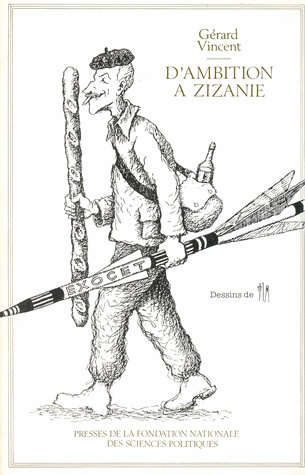
D'Ambition à Zizanie
Lexique illustré de la France contemporaine
First Edition
«Classes sociales. Classe ouvrière, classe populaire, classe moyenne (au singulier ou au pluriel), classe supérieure ou dominante, classes favorisées, autant d'expressions qui appartiennent au langage commun et aux discours politiques. Read More
Specifications
- Publisher
- Presses de Sciences Po
- Illustrated by
- Tim,
- Author
- Gérard Vincent,
- Collection
- Académique
- Language
- French
- Publisher Category
- > Sociology > Political Sociology
- Publisher Category
- > Politics
- BISAC Subject Heading
- POL000000 POLITICAL SCIENCE
- Onix Audience Codes
- 06 Professional and scholarly
- CLIL (Version 2013-2019)
- 3283 SCIENCES POLITIQUES
- Title First Published
- 1983
- Subject Scheme Identifier Code
- Thema subject category: Politics and government
Livre broché
- Product Detail
- 1
- Publication Date
- 21 April 2023
- ISBN-13
- 9782724640854
- Product Content
- Text (eye-readable)
- Extent
- Main content page count : 274, Front matter page count (Roman) : 274
- Code
- 9782724640854
- Dimensions
- 12.5 x 19 cm
- Weight
- 350 grams
- ONIX XML
- Version 2.1, Version 3
ePub
- Product Detail
- 1
- Publication Date
- 21 April 2023
- ISBN-13
- 9782724640878
- Product Content
- Text (eye-readable)
- Code
- 9782724640878
- Technical Protection ebook
- Adobe DRM
- ONIX XML
- Version 2.1, Version 3
Google Book Preview
Contents
Introduction
Une fédération d'États
Un régime semi-parlementaire
PREMIÈRE PARTIE – L'UNION ET SES ÉTATS
Chapitre 1 – L’européanisation et ses limites
Les compromis fondateurs
Grande politique et fonctionnalisme
Politique et technocratie
Marché et régulation
Une rupture des équilibres fondateurs ?
Un tournant libéral
Maastricht, aboutissement ou nouveau départ ?
Les dynamiques de l’européanisation
Les pressions extérieures
La convergence des idées
La médiation des institutions
Chapitre 2 – Une intégration à intensité variable
Dans quelles sphères l’Union peut-elle agir ?
Les politiques de sécurité
Les politiques de l’identité
Les politiques institutionnelles
L’encadrement du marché
Comment se font les politiques de l’Union ?
La méthode communautaire
La coopération intergouvernementale
La « coordination ouverte »
La régulation centralisée
Chapitre 3 – L’équilibre entre les niveaux de pouvoir
L’Union sous le contrôle des États
L’affirmation du principe de subsidiarité
La pratique de la subsidiarité
Les États sous le contrôle de l’Union
DEUXIÈME PARTIE – UN RÉGIME POLITIQUE ACÉPHALE
Chapitre 4 – Le « modèle communautaire »
L’omniprésence des gouvernements
Le rôle médiateur de la Commission
Pourquoi la Commission ne peut pas être un gouvernement européen
Gouvernement, administration ou agence ?
Logiques de la collégialité
Chapitre 5 – La parlementarisation du régime de l’Union
La formation du consensus dans une assemblée divisée
Logiques de la codécision
Une démocratie de consensus
Chapitre 6 – Les politiques des juges
Pourquoi une Cour ?
Les juges face aux politiques : une prudente audace
Les politiques face aux juges : la servitude volontaire
Le troisième âge de la Cour
TROISIÈME PARTIE – UNE DÉMOCRATIE ANONYME
Chapitre 7 – Une vie politique morcelée
La polyphonie des intérêts
Des relations fluctuantes
Le filtrage des intérêts
Des partis embryonnaires
Les limites structurelles au développement des partis européens
L’ébauche d’une polarisation idéologique
Des opinions peu structurées
Chapitre 8 – Vers une démocratie transnationale ?
Le tropisme parlementaire
La « gouvernance démocratique »
La déstructuration politique de l’Europe
Vers un espace public transnational ?
Chapitre 9 – Être citoyen européen
Le décloisonnement des citoyennetés nationales
Vers une conscience civique commune ?
Conclusion
L’État consolidé, la nation décrispée
Un pouvoir régulateur
Un régime hybride
Une puissance civile
La politique du compromis
Bibliographie
Index des noms