Raisons politiques 46, mai 2012
Consentement sexuel
Première édition
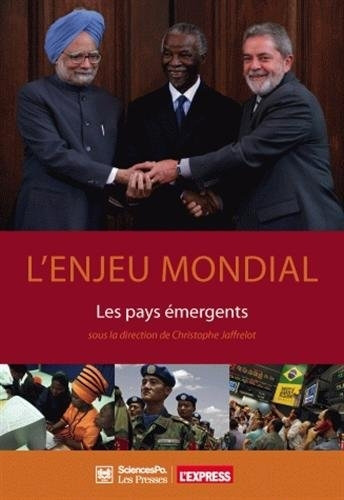
Les pays émergents rebattent les cartes du jeu international. Que pèsent-ils réellement ? Comment résisteront-ils à la crise qui commence ? ... Lire la suite
Les pays émergents jouent un rôle croissant sur la scène internationale sans qu'on mesure encore la portée de leur essor, ni même que l'on fasse toujours l'effort de les identifier précisément. Que pèsent-ils réellement ? Qu'ont-ils d'autre en commun sinon de susciter l'appréhension des pays riches ? Comment résisteront-ils à la crise qui commence ?
Pouvant se lire au gré de l’intérêt de chacun, L’Enjeu mondial dresse le panorama des pays émergents en quatre volets : la généalogie de l’émergence, les trajectoires de sept nations et trois régions, les changements suscités par leur essor dans l’ordre économique, politique et militaire, et enfin, les limites du phénomène, liées au creusement des inégalités et aux contraintes environnementales.
Sous la direction de Christophe Jaffrelot, directeur du CERI (Centre d’études et de recherches internationales de Sciences Po), avec la collaboration des meilleurs spécialistes, L’Enjeu mondial se propose d’éclairer l’un des grands enjeux mondiaux contemporains, combinant analyses et cartographie inédites.
Ont contribué à cet ouvrage : Rolando Avendaño • François Bafoil • Geoff Barnard • Robert Boyer • Jean Coussy • Olivier Dabène • Dominique Darbon • Jean-Luc Domenach • Gilles Favarel-Garrigues • Jean-Jacques Gabas • Pierre-Noël Giraud • François Godement • Emmanuel Guérin • Jérôme Guillet • Pierre Hassner • Guy Hermet • Jean-François Huchet • Ahmet Insel • Christophe Jaffrelot • Françoise Lemoine • Bruno Losch • Roland Marchal • Alexandra Novosseloff • Imène Rahmouni-Rousseau • David Recondo • Alain Rouquié • Joël Ruet • Javier Santiso • Jérôme Sgard • Jean-Marc Siroën • Anne de Tinguy • Laurence Tubiana • Cornelia Woll.
Spécifications
- Éditeur
- Presses de Sciences Po
- Auteur
- ,
- Revue
- Raisons politiques
- ISSN
- 12911941
- Langue
- français
- BISAC Subject Heading
- POL000000 POLITICAL SCIENCE
- Code publique Onix
- 06 Professionnel et académique
- CLIL (Version 2013-2019 )
- 3283 SCIENCES POLITIQUES
- Date de première publication du titre
- 01 octobre 2008
- Code Identifiant de classement sujet
- Classification thématique Thema: Politique et gouvernement
Livre broché
- Date de publication
- 01 juillet 2012
- ISBN-13
- 978-2-7246-3264-4
- Code interne
- 9782724632644
- Format
- 15,5 x 24 x 0,8 cm
- Poids
- 350 grammes
- Prix
- 18,50 €
- ONIX XML
- Version 2.1, Version 3
Google Livres Aperçu
Sommaire
Consentement sexuel
Éditorial
L'enjeu du consentement
Alexandre Jaunait et Frédérique Matonti
Dossier
Coordonné par Frédérique Matonti, Alexandre Jaunait et Sébastien Chauvin
Frédérique Matonti
Les mots pour (ne pas) le dire. Viol, consentement, harcèlement : les médias face aux affaires Strauss-Kahn
Éric Fassin
Au-delà du consentement : pour une théorie féministe de la séduction
Bertrand Guillarme
Deux critiques du consentement
Pierre-Yves Quivigier
Du droit au consentement. Sur quelques figures contemporaines du paternalisme, des sadomasochistes aux Témoins de Jéhovah
Béatrice de Gasquet
Catharine MacKinnon, féministe systématique
Catharine A. MacKinnon
« Sexuality »
Parcours de recherche : Gayle Rubin
Rostom Mesli
Une conversation avec Gayle Rubin
Varia
Gaëlle Demelemestre
Le concept lefortien du pouvoir comme lieu vide. Paradoxes de la société démocratique moderne
Annette Disselkamp et Richard Sobel
L’ambivalence politique du « social » dans les sociétés capitalistes : Arendt avec Castel
Lectures critiques
Georges Meyer
Énigmes et complots. Une enquête à propos d’enquêtes de Luc Boltanski
Événements précédents