
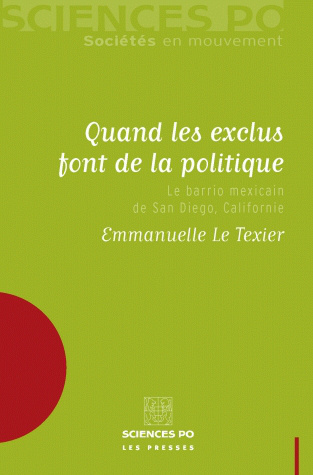
Quand les exclus font de la politique
Le barrio mexicain de San Diego - Californie
First Edition
The book conveys a portrait of a marginalized population that plays an important role in one of the major American border city. Read More
In this book, the author questions the notion of political apathy applied to excluded people, in particular to Mexican-origin barrio residents in America. Starting with an interrogation about what is political and with a revision of classical political participation models and concepts that served to define non-participation in the Latino barrios, she shows that these approaches build an implicit link between social disorganization and political apathy. She deconstructs this link with a theoretical reflection on the concept of “pre-politics”, arguing that classical concepts such as “underclass” and “culture of poverty” are of limited interest, that socioeconomic factors are determinant in explaining apathy in these areas, but that institutional factors are even more influent to determine exclusion from the political sphere.
Last, she points out the existence of “daily political practices”, based on gender and identity dynamics which define a specific social organization and collective identity.
Click here to buy from these retailers:


Specifications
- Publisher
- Presses de Sciences Po
- Author
- Emmanuelle Le Texier,
- Collection
- Académique
- Language
- French
- Tags
- , , , , International Relations, United States of America
- Publisher Category
- > Sociology > Society
- Publisher Category
- > Sociology > Society
- Publisher Category
- > Exams
- Publisher Category
- > Society
- BISAC Subject Heading
- POL000000 POLITICAL SCIENCE
- Onix Audience Codes
- 06 Professional and scholarly
- CLIL (Version 2013-2019)
- 3283 SCIENCES POLITIQUES
- Title First Published
- 07 September 2006
- Subject Scheme Identifier Code
- Thema subject category: Politics and government
Paperback
- Publication Date
- 29 October 2012
- ISBN-13
- 978-2-7246-1275-2
- Extent
- Main content page count : 430
- Code
- 978-2-7246-1275-2
- Weight
- 328 grams
- List Price
- 24.00 €
- ONIX XML
- Version 2.1, Version 3
Google Book Preview
Contents
Première partie / LE CONTEXTE DE LA FORMULATION DE LA POLITIQUE ÉTRANGERE
Louis Balthazar
Chapitre 1 / LE CADRE CONSTITUTIONNEL
L'héritage des Pères fondateurs
Les institutions constitutionnelles de la politique étrangère
Les débats constitutionnels
Chapitre 2 / LE CADRE CULTUREL : LE STYLE NATIONAL
Les éléments fondateurs du style national
Les tendances profondes du style national
L'évolution du style national
Chapitre 3 / LE CADRE CONCEPTUEL : LES GRANDS COURANTS DE PENSÉE POLITIQUES
L'histoire des grands courants de pensée politiques
Les grands courants de pensée contemporains
Chapitre 4 / LE CADRE THÉORIQUE : LES APPROCHES ACADÉMIQUES
L'unilatéralisme par le contrôle du système international
Le multilatéralisme par la direction du système international
Le minimalisme par l'abstention au niveau international
Deuxième partie / LE POUVOIR EXÉCUTIF AU COEUR DE L'ACTION INTERNATIONALE
Charles-Philippe David
Chapitre 5 / UNE PRÉSIDENCE TOUJOURS IMPÉRIALE
L’autorité du président en politique étrangère
L’approche décisionnelle du président en politique étrangère
Chapitre 6 / LES ACTEURS DU JEU BUREAUCRATIQUE
Le rôle classique de la diplomatie et de la Défense
Le rôle repensé des services de renseignement et de la sécurité intérieure
Le rôle accru des ministères traditionnels
L’impact du jeu bureaucratique sur la prise de décision
Chapitre 7 / L'INFLUENCE DU CONSEIL DE SÉCURITÉ NATIONALE
La mise en place du NSC
Le processus décisionnel au sein du NSC
L’évolution du NSC dans le jeu de la politique étrangère
Troisième partie / LE POUVOIR LÉGISLATIF ET LE POIDS DE LA SOCIÉTÉ CIVILE
Justin Vaïsse
Chapitre 8 / LE CONGRES
Les pouvoirs du Congrès
L’organisation du Congrès
Chapitre 9 / LE RÔLE DE L’OPINION PUBLIQUE
La perception du monde par l’opinion publique américaine
Un triangle d’influence réciproque : le président, l’opinion publique et les médias
Chapitre 10 / LA SOCIÉTÉ CIVILE ORGANISÉE
Un foisonnement d’organisations représentant la société civile
Les moyens d’influence des intérêts particuliers sur la politique étrangère
Conclusion / CONTINUITÉ ET CHANGEMENTS DANS LA FORMULATION DE LA POLITIQUE ÉTRANGÈRE AMÉRICAINE
Les adaptations au nouvel environnement stratégique
Une nation en guerre
Le rôle de l’Administration Bush dans le tournant pris par la politique étrangère américaine