
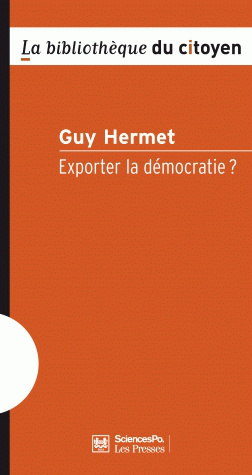
Exporter la démocratie ?
Second Edition
Is democracy exportable? How does the democratic spirit arise in people, and in effect, how does one become a citizen of a democracy? And how is democracy established given the difficulties present where it would exist? What have been called democratic transitions have inspired hope for nearly thirty years, what with the fall of dictatorship in Spain and the disappearance of military regimes in Latin America, followed by the end of the Communist domination of Eastern Europe. But the hour of dissolution has sounded quickly in the wake of the rending apart of the former Yugoslavia and the Caucasus, the drift toward "authoritarian democracy" in Russia, the political impasse in Africa or greater still the corruption of liberty undertaken by current religious fundamentalists, as in the "ballistic democracy" of the Middle East.
Succumbing neither to absolute pessimism nor to blindness, this work reviews the likelihood of the consolidation of young democracies and the establishment of numerous, enduring authoritarian systems. It reminds us that the phenomenon of democratization is nothing new, and that it affected, in its time, Western Europe. This book then examines the obstacles blocking the way as the crucial role of political actors, who succeed or fail in the forever hazardous enterprise of a passage into democracy. Finally it observes how the classic democratic model again finds itself in competition with today's “illiberal” democracies, or by the combination of economic permissiveness and political inflexibility which today characterizes the “Beijing consensus.”
Click here to buy from these retailers:


Specifications
- Publisher
- Presses de Sciences Po
- Edition
- 2
- Author
- Guy Hermet,
- Collection
- Bibliothèque du citoyen
- Language
- French
- Tags
- , , Citizenship, Democracy, democratic transition
- Publisher Category
- > International
- Publisher Category
- > International field
- Publisher Category
- > Political Science
- Publisher Category
- > Politics
- BISAC Subject Heading
- POL000000 POLITICAL SCIENCE
- Onix Audience Codes
- 01 General / trade
- CLIL (Version 2013-2019)
- 3283 SCIENCES POLITIQUES
- Title First Published
- 08 August 2008
- Subject Scheme Identifier Code
- Thema subject category: Politics and government
Paperback
- Publication Date
- 08 August 2008
- ISBN-13
- 978-2-7246-1078-9
- Extent
- Main content page count : 140
- Code
- 978-2-7246-1078-9
- Weight
- 150 grams
- List Price
- 10.50 €
- ONIX XML
- Version 2.1, Version 3
ePub
- Publication Date
- 08 August 2008
- ISBN-13
- 9782724687057
- Product Content
- Text (eye-readable)
- Extent
- Main content page count : 140
- Code
- 9782724687057
- Technical Protection ebook
- Adobe DRM
- List Price
- 6.99 €
- ONIX XML
- Version 2.1, Version 3
Google Book Preview
Contents
INTRODUCTION
CHAPITRE 1. De quoi parle-t-on ?
Un gouvernement représentatif nommé démocratie
Démocratie politique, démocratie sociale, démocratie sans adjectif
Le seuil de la démocratie
CHAPITRE 2. Les démocraties fondatrices
L'hydre du suffrage universel
Les urnes contre la révolution
L'invention de l'État providence
CHAPITRE 3. Les démocratisations tardives
Les défaites de la démocratie
La vague démocratique de 1945
Les démocratisations latines
L'après-communisme
CHAPITRE 4. L’installation de la démocratie
L’abandon du navire
La distribution des rôles
La gestion des risques
L’agenda des priorités
CHAPITRE 5. La démocratie est-elle exportable ?
Les doctrines de la prédestination autoritaire
La démocratie sans conditions ?
Le retour de la démocratie avec adjectif
Du triomphe des droits de l’homme à la démocratie balistique
CHAPITRE 6. Comment devient-on démocrate ?
Le citoyen introuvable
Le débat théorique
Le débat pratique
La démocratie comme exercice ?
Entre le défi de l’islam et le consensus de Pékin
CONCLUSION