
Eglises en réseaux

Trajectoires politiques entre Europe et Amérique
Première édition

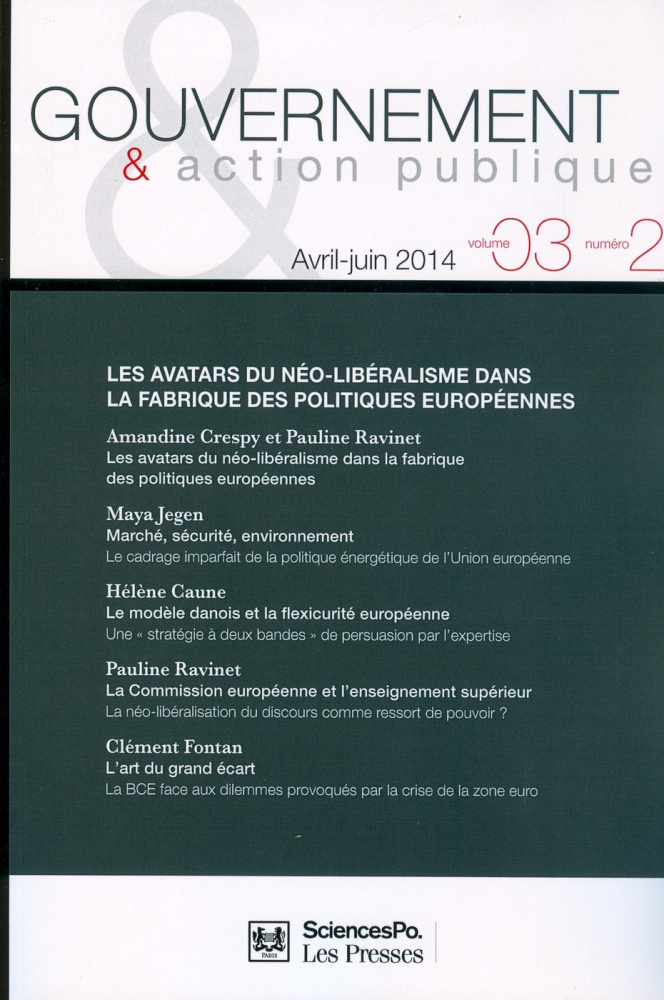
Tables of contents: Competition, security and climate change European flexicurity and the danish model The European commission and higher education Facing ideational dillemmas: The European Central Bank During the Eurozone crisis Lire la suite

AVATARS OF NEOLIBERALISM IN EU POLICY-MAKING
This special issue deals with the institutionalization of neoliberal ideas in European policy-making. The introductory article considers that European ideas are not fixed at the European level and then implemented with variations at the national level. On the contrary, the European policy process generates avatars of neoliberalism, that is modified and reshaped forms of neoliberal policy solutions which are negotiated already at the stage of policy formulation. This article develops an approach emphasizing agents' political work in contrasted and changing institutional settings in order to explain the different forms of European neoliberal policies. This innovative approach is substantiated by the articles gathered in this issue which deal with different EU policy sectors (monetary policy, energy, employment and higher education).
KEYWORDS: EU POLICY-MAKING – IDEAS – INSTITUTIONAL CONFIGURATION – NEOLIBERALISM –POLITICAL WORK

COMPETITION, SECURITY AND CLIMATE CHANGE: EUROPEAN ENERGY
POLICY AND THE LIMITS OF FRAMING

Despite its lack of strong competences in this field, the European Commission has sought to develop a common energy policy. This article shows how the Commission has skilfully framed a common energy policy by linking the construction of the internal energy market to climate change and secure and stable supplies of energy, in order to legitimize its intervention in a policy field that was traditionally considered as a prerogative of the Member States. To some extent, this frame has been institutionalized and resonates with Member States. The comparison of Germany and Poland illustrates that the effectiveness of this framing follows from its heterogeneous nature. Yet, the Commission’s discursive strategy reaches institutional and material limits and reveals contradictions. We examine the institutional and structural conditions explaining the success or the failure of the framing.
KEYWORDS: ENERGY AND CLIMATE POLICY – FRAMING – EUROPEAN UNION

EUROPEAN FLEXICURITY AND THE DANISH MODEL: A TWO-STEPS STRATEGY
OF PERSUASION THROUGH EXPERTISE

The European model of flexicurity reconciles flexibility on the labour markets and security for the workers. The article examines how political and bureaucratic actors of the European Commission have adapted to a challenging political and institutional context. The Danish "golden triangle of flexicurity" has first helped to get around strong opposition from European trade unions’ representatives. This framing had then to be softened in order to avoid Member States reluctance to adopt such a national framing. This article explains why some experts, and not others, have been mobilised. It underlines the strategic dimension of expertise and evaluates its effects on the weakening of political conflict.
KEYWORDS: EUROPEAN UNION – EMPLOYMENT POLICIES – FLEXICURITY – DANISH MODEL – TRADE-UNIONS

THE EUROPEAN COMMISSION AND HIGHER EDUCATION: NEOLIBERALISATION OF DISCOURSE AS A MEANS OF POWER?
This articles studies the evolution of the discursive strategy of the European Commission in the domain of higher education. It seaks to explain if and how a neoliberalised discourse is a ressource in a sector with very limited formal EU competence. The article analyses the initial discursive link between European higher education and market, and the way it has been shaped depending upon institutional conditions and political work of actors. In the actual situation, Commission has a much more clearly neoliberal dicourse, which nevertheless does not make the institution as powerful as often stated. The Commission has actually to deal with the Bologna process, or mechanism of coordination of HE policies that developed on the margins of the EU, and which has a slightly different ideological echo (i.e. less neoliberal). The Bologna process has institutionalised and developped a specific identity and working culture and is not so easy to control or absorb for the European Commission.
KEYWORDS: BOLOGNA PROCESS – DISCURSIVE STRATEGY – EUROPEAN COMMISSION – HIGHER EDUCATION – NEOLIBERALISM

FACING IDEATIONAL DILLEMMAS: THE EUROPEAN CENTRAL BANK DURING
THE EUROZONE CRISIS

This article aims at answering two central questions: Why did the European Central Bank kept on defending an orthodox model of central banking while its response to the crisis deviated from it – and how did it manage to do so? I explain first how ideas were decisive for the ECB creation by focusing on the diffusion of the concepts of the new classical macro economy and on the orthodox model of the Bundesbank. Yet, the ECB implementation of heterodox monetary measures in order to answer to the eurozone crisis triggered internal and external tensions which endangered its organizational unity. The ECB dilemma consisted thus in implementing the necessary crisis measures while protecting its original orthodox reputation. I adopt a constructivist grid of analysis in order to analyse how it did so in its official communication and in the instrumentation of its monetary policy. Finally, I show that these strategies helped the ECB agents to protect and enhance their reputation within crucial Ecofin arenas.
KEYWORDS: EUROPEAN CENTRAL BANK – EUROZONE CRISIS – ORDO-LIBERALISM – STRATEGIC CONSTRUCTIVISM


Livre broché - 23,00 €

Spécifications


Éditeur
Presses de Sciences Po
Auteur
Ariel Colonomos,
Collection
Académique
Langue
French
Mots clés
, , Europe, Religions
Catégorie (éditeur)
Internet Hierarchy > Sociologie > Sociétés en mouvement
Catégorie (éditeur)
Internet Hierarchy > International
Catégorie (éditeur)
Internet Hierarchy > Monde & sociétés
Catégorie (éditeur)
Internet Hierarchy > Société
BISAC Subject Heading
POL000000 POLITICAL SCIENCE
Code publique Onix
06 Professionnel et académique
CLIL (Version 2013-2019 )
3283 SCIENCES POLITIQUES
Crédit
Presses de Sciences Po
Date de première publication du titre
23 juin 2014
Code Identifiant de classement sujet
Classification thématique Thema: Politique et gouvernement

Paperback


Date de publication
01 janvier 2000
ISBN-13
978-2-7246-0789-5
Ampleur
Nombre de pages de contenu principal : 315
Code interne
9782724607895
Poids
430 grammes
Prix
23,00 €
ONIX XML
Version 2.1, Version 3

Google Livres Aperçu


Sommaire


LES PREMIÈRES TRAJECTOIRES À L'ÂGE MODERNE

Chapitre 1 Les églises à l'épreuve du schéma westphalien
La diffusion de la Réforme et ses conséquences internationales
La guerre des jésuites
La sécurité identitaire et les figures ambiguës de la rationalité
Les deux versants de la sécularisation
L'entreprise jésuite dans les mailles du jeu westphalien

PREMIÈRE PARTIE LES DYNAMIQUES DE LA GUERRE FROIDE

Chapitre 2 Déviance religieuse et ingérence politique
Les trajectoires internationales de la libération entre espace régional et dynamique mondiale
Les accusations d'ingérence : les sectes nord-américaines

Chapitre 3 Les institutions protestantes dans le contexte bipolaire
La question de l'institution protestante
L'œcuménisme comme tradition internationale
L'exportation de l'œcuménisme politique en Amérique latine
La moralisation du capitalisme depuis les rives de l'Hudson

Chapitre 4 La modernisation conservatrice
La métaphore économique et 1 'empowerment : des idées d'avenir
La professionnalisation du religieux dans les affaires
La professionnalisation du religieux par le droit

Chapitre 5 Le tropisme américain
Les premiers itinéraires de la prédestination
Le retournement du wilsonisme
Les nouveaux condottieri protestants
Les faucons et les ratages de l'escalade

DEUXIÈME PARTIE DES ÉGLISES DANS LA TOURMENTE GLOBALE

Chapitre 6 La reproduction latine
Les nouveaux croisés du Sud
Des nouveaux venus, l'internationale de partis chrétiens
Les charismatiques comme parias

Chapitre 7 La relecture des grands récits internationaux
Les mythes politiques
Les mythes politico-économiques : de l'antisémitisme au philosionisme
Les mythes économiques : les marchés émergents de la foi

Chapitre 8 L'église, entreprise de l'après-guerre froide
Église et capitalisme entre théorie et pratique internationales
Le pluralisme concurrentiel depuis le Vatican
Une liberté de conscience mondiale ?
Les usages internationaux du webérianisme

Chapitre 9 De nouveaux modes d'action diplomatiques
La gouvernance des identités
L'économie internationale de la dette et la civilité vaticane