
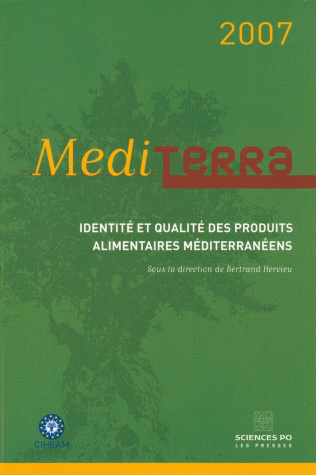
MEDITERRA 2007
Identity and quality of mediterranean foodstuffs
First Edition
Mediterra has focused this first edition on the questions of the identity, safety and quality of Mediterranean foodstuffs. Read More
Mediterra has focused this first edition on the questions of the identity, safety and quality of Mediterranean foodstuffs, thus highlighting the impact of designations of origin as a quality guarantee and a shield for many Mediterranean countries against imitation and relocation. The work presents a rigorous analysis of the risks in this field as well as consumer perceptions in order to specify the role played by identity, safety and quality in market construction. The milk industry is then taken as an example to illustrate future prospects and the policies implemented by a number of Mediterranean countries. The CIHEAM annual report, now entitled Mediterra, is a reference document which has been published since 1999 and reflects the development of the agricultural sectors in the countries bordering the Mediterranean. Maps, charts and tables provide details of the agricultural development indicators. Mediterra is published in five languages (French, English, Spanish, Arabic and Italian) and provides a basis for discussion and decision-making by policymakers and professionals. Mr. Bertrand Hervieu, the current Secretary-General of the International Centre for Advanced Mediterranean Agronomic Studies (CIHEAM), is the scientific editor of Mediterra. The CIHEAM is an intergovernmental organisation, which was established in 1962 and now has thirteen Member States in the Mediterranean basin; it has gradually come to be recognised as an authority in the fields of agriculture, food and rural development in the Mediterranean region.
 This title is also available in
Specifications
- Publisher
- Presses de Sciences Po
- Author
- CIHEAM,
- Language
- French
- Tags
- Publisher Category
- > Europe > European Politics
- Publisher Category
- > Geopolitics > Sustainable Development
- Publisher Category
- > Environment
- Publisher Category
- > International field
- Publisher Category
- > Political Economics
- Publisher Category
- > Politics
- Publisher Category
- > Society
- BISAC Subject Heading
- POL000000 POLITICAL SCIENCE
- Onix Audience Codes
- 06 Professional and scholarly
- Title First Published
- 23 May 2007
- Subject Scheme Identifier Code
- Thema subject category: Politics and government
Paperback
- Publication Date
- 23 May 2007
- ISBN-13
- 978-2-7246-1028-4
- Illustrations
- illustrations, color
- Extent
- Main content page count : 364
- Code
- 9782724610284
- Weight
- 700 grams
- List Price
- 15.00 €
- ONIX XML
- Version 2.1, Version 3