
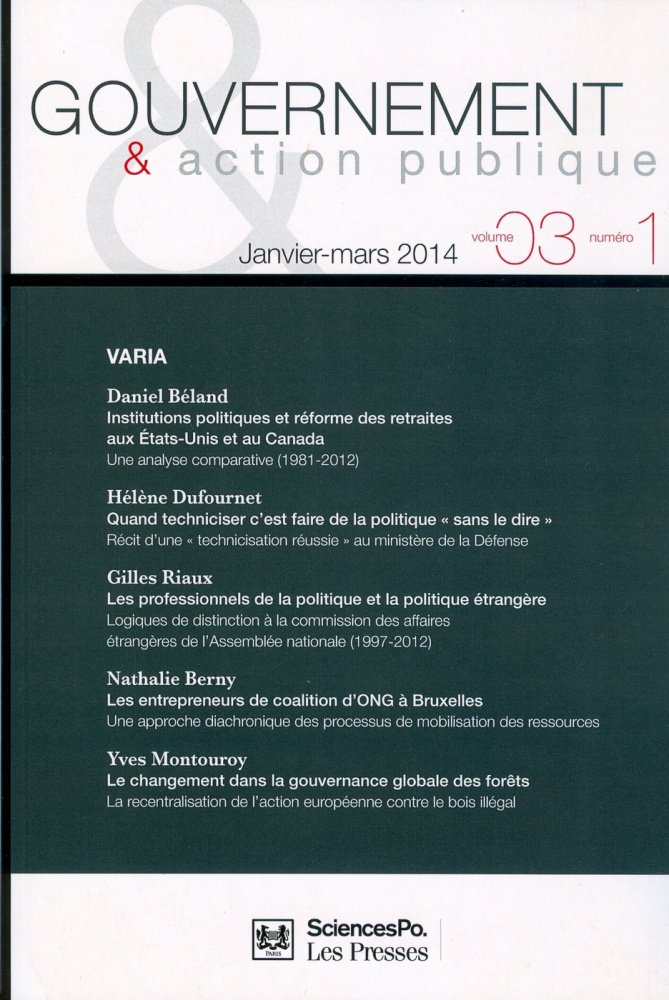
Gouvernement & action publique 03-1, janvier-mars 2014
Varia
First Edition
Table of contents: Political Institutions and Pensions Reforms in the US and Canada - Technisization, a Silent Way of Doing Politics - Politicians ans Forein Policy - The Coalition Entrepreneurs in Brussels - Change in Global Forest Governance. Read More
POLITICAL INSTITUTIONS AND PENSIONS REFORMS IN THE UNITED STATES AND CANADA: A COMPARATIVE ANALYSIS (1981-2012)
Focusing on institutional factors and the strategies of political actors, this article studies institutional change in the field of pension policy in the United States and Canada since the early 1980s. In pension reform as in other policy areas, it is appropriate to compare these two "liberal" countries which, while leaving a large role to the market, have developed distinct political institutions and social programs. The article emphasizes both the weight of some of these institutional differences and the existence of common reform strategies in the two countries under study. Focusing on public pension systems while taking into account savings and private pensions, the article takes a historical approach by contrasting three periods in each country: the Reagan (1981-1989) and the Mulroney years (1984-1993), the Clinton (1993-2001) and the Chrétien years (1993-2003), and the George W. Bush (2001-2009) and the Harper years (2006-).
KEYWORDS: CANADA – INSTITUTIONS – OLD-AGE PENSIONS – POLITICAL STRATEGIES – PUBLIC POLICY – UNITED STATES
TECHNISIZATION, A SILENT WAY OF DOING POLITICS. A SUCCESS STORY IN THE DEFENSE MINISTRY
Abstract: This paper deals with the conditions and the ways in which the French Ministry of Defense works on the subject of cluster munitions. Strictly opposed to a specific ban on these weapons, civil servant of the headquarters managed to build a position which justifies the upholding of the status quo on the issue. A broad consensus emerged on this position among diplomats and military actors, among administrations and political decision-makers. This paper focus on the conditions of the diffusion of this characterization of the problem in the French politico-administrative system. It shows how the humanitarian issue of cluster munition is reframed into a technical one which owes its success, not to a fictitious business decision of politics inherent in a technocratic model of decision-making, but rather to the consideration of political imperatives. Therefore, increase the technicality of the issue does not correspond here to a “depoliticization” but rather to an “a-politicization” which intends to make the political aspects of the problem disappear.
KEYWORDS: ADMINISTRATIONS – LEGITIMATION – POLITICS – PUBLIC POLICY ANALYSIS
POLITICIANS AND FOREIGN POLICY. HOW TO BECOME A MEMBER OF THE FOREIGN AFFAIRS COMMITTEE OF THE FRENCH NATIONAL ASSEMBLY (1997-2012)
This article deals with MPs standing in the Foreign Affairs Committee of the French National Assembly. It aims to examine the relations between political career and the sector division in parliamentary work. This study is based on a statistical survey of the representatives who were member of the Foreign Affairs Committee between 1997 and 2012. Additional data has been collected from interviews of a sample of representatives sitting in this committee. Representatives specialized in diplomatic matters have a higher number of parliamentary mandates and ministerial positions during their political career. The Foreign Affairs Committee draws mainly politicians who have a long and successful career behind them and can justify the necessary skills to deal with foreign policy. The sector division of labor in the National Assembly participates in maintaining the differentiation between high and low politics in the polity.
KEYWORDS: ELITES – FOREIGN POLICY – PARLIAMENT – POLITICAL CAREER – SECTOR DIVISION
THE COALITION ENTREPRENEURS IN BRUSSELS: A DIACHRONIC APPROACH OF RESOURCES MOBILISATION PROCESSES
Since the end of the 90s, the number of European non-governmental organisations (NGOs) established in Brussels has dramatically increased. The European Union (EU) institutions have supported the establishment of many NGOs, which has given creditability to the view that these organisations and their coalitions were artificially maintained. This article engages with this view by examining the logics of collective action within two coalitions, respectively bringing together national and European NGOs. The concept of entrepreneurship offers here analytical leverage that can explain both how they emerge and how they evolve over time. The ensuing empirical discussion provides a comparison between NGOs, underscoring the leeway they can have in the EU arena.
KEYWORDS: COALITION – ENTREPRENEUR – EUROPEAN UNION – INTEREST GROUP – NON-GOVERNMENTAL ORGANIZATION – SOCIAL MOVEMENT
CHANGE IN GLOBAL FOREST GOVERNANCE: RECENTRALIZATION OF EUROPEAN RULE MAKING TO COUNTER ILLEGAL LOGGING
In 2003, the EU approved an Action Plan to counter illegal logging by strengthening international cooperation and national authorities in developing countries. At first glance, this EU intervention appears to deeply challenge the global governance of forestry which has progressively been privatized. However, I argue that a recentralization of power in the regulation of the sector has led to a contentious relationship between public and private rulemaking. Here I demonstrate how the EU FLEGT regulation emerged as part of a change in the complex governance of forests. Consequently, I analyze the collective construction of the European intervention and its effects upon the complex governance of forestry and wood industry trade practices.
KEYWORDS: CERTIFICATION SCHEMES – EU – FLEGT – ILLEGAL LOGGING – INDUSTRY – INSTRUMENTS – POLITICAL WORK – REGULATION
Specifications
- Publisher
- Presses de Sciences Po
- Author
- ,
- Journal
- Gouvernement & action publique
- ISSN
- 22600965
- Language
- French
- BISAC Subject Heading
- POL000000 POLITICAL SCIENCE
- Onix Audience Codes
- 06 Professional and scholarly
- Credit
- Presses de Sciences Po
- Title First Published
- 01 April 2014
- Subject Scheme Identifier Code
- Thema subject category: Politics and government
- Type of Work
- Journal Issue
Paperback
- Publication Date
- 01 April 2014
- ISBN-13
- 978-2-7246-3354-2
- Product Content
- Text (eye-readable)
- Extent
- Main content page count : 156
- Code
- 9782724633542
- Dimensions
- 16 x 24 x 1.2 cm
- Weight
- 176 grams
- List Price
- 20.00 €
- ONIX XML
- Version 2.1, Version 3
Google Book Preview
Contents
Institutions politiques et réforme des retraites aux États-Unis et au Canada
Une analyse comparative (1981-2012)
Daniel Béland
Quand techniciser c'est faire de la politique « sans le dire »
Récit d'une « technicisation réussie » au ministère de la Défense
Hélène Dufournet
Les professionnels de la politique et la politique étrangère
Logiques de distinction à la commission des affaires étrangères de l’Assemblée nationale (1997-2012)
Gilles Riaux
Les entrepreneurs de coalition d’ONG à Bruxelles
Une approche diachronique des processus de mobilisation des ressources
Nathalie Berny
Le changement dans la gouvernance globale des forêts
La recentralisation de l’action européenne contre le bois illégal
Yves Montouroy
LECTURES
Lecture croisée : Sociologie des politiques d’éducation : de la fabrique des réformes à leur mise en oeuvre
par Séverine Chauvel
Romuald Normand (2011), Gouverner la réussite scolaire. Une arithmétique politique des inégalités, Berne, Peter Lang
Lorenzo Barrault (2013), Gouverner par accommodements. Stratégies autour de la carte scolaire, Paris, Dalloz
Comptes rendus
Aude-Claire Fourot (2013), L’Intégration des immigrants. Cinquante ans d’action publique locale, Montréal, Presses de l’Université de Montréal
par Anne Mévellec
Edwin Zaccai, François Gemenne, Jean-Michel Decroly (dir.) (2012), Controverses climatiques, sciences et politique, Paris, Presses de Sciences Po
par Yann Bérard
Jean-Noël Jouzel (2012), Des toxiques invisibles. Sociologie d’une affaire sanitaire oubliée, Paris, Éditions de l’EHESS, coll. « Cas de figure »
par Thibault Bossy
Béatrice Hibou (dir.) (2012), La Bureaucratisation néolibérale, Paris, La Découverte
par Matthieu Ansaloni
Jean-Michel Eymeri-Douzans, Geert Bouckaert (dir.) (2013), La France et ses administrations : un état des savoirs/France and its Public Administrations: A State of the Art, Bruxelles, Bruylant, coll. « Public Administration Today/Administration publique aujourd’hui »
par Meryll David-Ismayil
Catherine Spieser (dir.) (2013), L’Emploi en temps de crise. Trajectoires individuelles, négociations collectives et action publique, Paris, Éditions Liaisons
par Josua Gräbener